The honest review
The pitch for Volcano House is not complicated. Hawaii Volcanoes National Park sits on the most volcanically active spot on earth. Halema'uma'u crater — a roughly half-mile-wide pit within the larger Kilauea caldera — has been in various states of active eruption for most of the last decade. The crater floor glows at night. During active eruption cycles, the lava lake visible from the rim has reached 100+ feet deep and illuminates the steam and gas plumes with an orange-red light that's visible for miles.
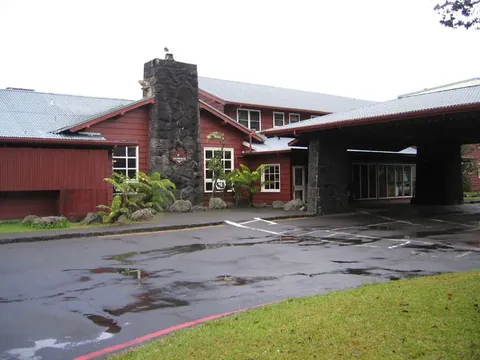
Volcano House sits on the crater rim. It has been there, in various incarnations, since 1846 — the oldest continuously operated hotel in Hawaii. The current structure is not a historic gem; it was substantially rebuilt, and it's more functional mountain lodge than architectural trophy. But the position is unmatched by any hotel in the continental US or Hawaii: you are literally on the edge of an active volcanic caldera.
For families, the experience unfolds in layers that few other US parks can match.
Day one: Arrive, drop bags, walk to the crater overlook (5 minutes from the hotel entrance). Watch the steam and gas columns. If there's active lava visible — check USGS HVO for current activity levels before your trip — the reaction from kids ages 7-14 is something between stunned silence and full volume excitement. Even during quieter periods when the lava lake is lower or inactive, the scale of the caldera is impressive: the crater is 3 miles wide, 500 feet deep, and sits inside a larger 2-mile-wide caldera. The numbers don't convey what standing on the rim conveys.
Day one evening: Uncle George's Lounge. This is a small bar off the hotel lobby with floor-to-ceiling windows facing the crater. At dusk and after dark, with a caldera-glow drink in hand (the cocktail list leans into the volcano theme), this is one of the more memorable experiences available in a US national park lodge. Kids can join for non-alcoholic options. The crater at night — even without active lava — reads differently than during the day: steam columns lit by ambient heat, the scale more apparent against the dark.
Day two: Crater Rim Drive and the lava tube. Thurston Lava Tube (officially Nahuku) is 2 miles from the hotel, a 0.3-mile loop through a lava tube cave big enough to walk through standing upright. Kids universally love this — it's a genuine cave, with good lighting, appropriate atmosphere, and a short enough walk that even 4-year-olds can do it (bring a light layer, it's cooler inside). The Kilauea Iki trail (4-mile loop, drops into a hardened lava lake from the 1959 eruption) is for kids 8+ with decent hiking shoes. Walking on a lava lake — crunchy, black, still faintly warm in some spots — is the kind of formative memory that sticks.
Day three: Chain of Craters Road. This is the Big Island underrated gem — a 20-mile drive from the summit elevation (4,000 feet) down to the coast (sea level), past dozens of pit craters, lava fields from the 1969-1974 Mauna Ulu eruption, petroglyphs (1,000-year-old carved images in the lava), and ending at sea cliffs where old lava flows hardened into the Pacific. Plan the full day: Holei Sea Arch at the bottom, Pu'u Loa petroglyph trail (2-mile round trip, flat, ancient Hawaiian rock carvings) on the way down, picnic at the coast.
The practical limits: Volcano Village (just outside the park) is 2 miles from Volcano House and has grocery options, the Kilauea Lodge restaurant (an excellent dinner alternative to the hotel), and Lava Rock Café for breakfast. You are 35 miles from the Hilo Costco (the right move for a fridge stock-up). The Kohala Coast resort cluster (Mauna Kea Beach Hotel, Fairmont Orchid, etc.) is 96 miles away — a 2.5-hour drive along the scenic North and South Kohala coast. Some families do a Big Island split stay: 2-3 nights at Volcano House for the volcano experience, then drive north to the Kohala resorts for 3-4 nights of beach/pool family time. This is a logical and very good Big Island family trip structure.
The room quality is honest-hotel caliber — clean, comfortable, not luxurious. Standard rooms are the same size as any mid-tier national park lodge room. If crater views matter to you (and they should), pay the premium for crater-side rooms. The garden-side rooms are significantly quieter but give you no volcanic vantage, which defeats part of the purpose.
Sulfur dioxide advisory: the park periodically issues Kīlauea haze ('vog') advisories that affect air quality, particularly when wind direction brings SO2 into the summit area. Families with asthma or young children sensitive to air quality should check USGS HVO air quality reports before visiting (they're updated daily at hvo.wr.usgs.gov). On most days the vog is mild and disperses; during active eruption cycles with high SO2 emissions, some trail areas are restricted. The hotel staff will always know current conditions.
Who this works for
Derived from FamilyFactor data
Toddlers
ages 0–3
Elementary
ages 4–8
Tweens
ages 9–12
Teens
ages 13+
Multi-gen
with grandparents
All amenities (10)↓
- Chain of Craters Road day trip (20-mile descent to the coast) accessible by car
- Crater Rim Drive access directly from property
- Kilauea Visitor Center 0.5 miles away — ranger programs, exhibits, eruption updates
- Ranger evening programs at Kilauea Visitor Center (family-focused, free with park admission)
- Rim-of-the-caldera location — Halema'uma'u crater overlook is a 5-minute walk
- Sulfur Banks and Steam Vents walks within 1 mile
- Summer: Kilauea Iki Crater hike (4-mile loop into and through a hardened lava lake) nearby
- The Rim Restaurant with floor-to-ceiling caldera views
- Thurston Lava Tube (Nahuku) — easy 0.3-mile loop, kids love the lava cave, 2 miles away
- Uncle George's Lounge with crater views (the best seat in the park)